
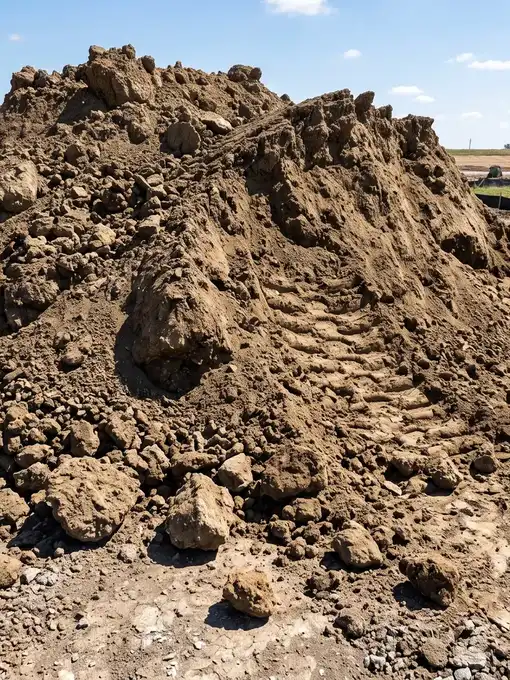
Fill Dirt Delivery in Leander, TX for Grading Jobs
Bulk fill dirt delivered in Leander, TX. Brown color.
Starting from $450.59 delivered to Leander for 2 tons, our minimum order
A backyard dip, a gap beside a new slab and a stump hole all want the same thing: more ground where there is too little. Fill dirt delivery in Leander, TX puts a bulk load of brown soil at the property so you can close those gaps without hauling it yourself.
What Leander projects use fill for
- Evening out a backyard dip before sod goes down.
- Backfilling a stump hole or a trench once the work has been inspected.
- Raising a low strip beside a driveway or sidewalk.
- Building a level area under a shed or small outbuilding.
Backfilled holes need the most care. Fill them in stages and let rain settle the surface before topping off, because a hole filled in one deep pour sinks in the middle as the soil underneath compresses.
Pick the top layer by how the surface will be used. Premium Screened Topsoil suits lawns and beds, and Mulch, sold by the cubic yard, finishes a planted border. The fill underneath only has to supply height.
Leander and the Austin side of town
Leander has about 90,000 residents and sits in the Austin metro area, with Cedar Park about 5 miles away and Austin about 22 miles. Lots run from newer subdivisions to larger parcels, so the same tonnage can mean a very different job from one street to the next. Check your own measurements instead of borrowing a figure from a neighbor's project. The Fill Dirt in Texas hub lists the statewide pages for this material.
Fill dirt delivery in Leander, TX
Type your ZIP code into the product page and it returns the delivered price for that address, so the cost is known before you place anything. Mark where the load should be tipped: firm ground, clear overhead, and as close to the work as the truck can safely get. The delivery in Leander page has the city-level details.
Before the truck arrives
- Call 811 if any digging is part of the job.
- Locate irrigation lines and sprinkler heads in the drop area.
- Walk the route in and note the width of any gate.
A few tons moved by wheelbarrow can take a day or more, so for a larger job it is worth lining up a skid steer or tractor before the soil lands.
Working out the tonnage
Take the length and width in feet and the depth in inches, multiply all three, and divide the result by 324. That gives cubic yards. A yard of this soil weighs about 2,200 pounds, so multiply by roughly 1.1 to turn yards into tons.
As a worked case, a 10 by 20 foot dip averaging 3 inches deep multiplies out to 600, which divided by 324 is about 1.9 cubic yards, or just over 2 tons. That happens to match the smallest order.
New soil settles, so build the surface a little above your target grade rather than exactly on it. The calculator runs the same conversion if you enter your measurements.
Leander pricing in tons
Tons are the unit here, and the smallest order is 2 tons. A larger order lowers the rate per ton, so if a job might need a few extra tons, adding them to one order costs less per ton than a second small order later. If the work is staged, say a patio now and a lawn later, the lower rate belongs to the bigger quantity, so decide up front how much can happen at once.
Placing a Leander order
Choose the tonnage on the product page and read the total before you pay. Write the measurements on the order note so any follow-up load can be sized from the same figures. If a builder or landscaper is on site, tell them the drop spot ahead of time so the load does not land in their way.
About Fill Dirt
About this material
Fill dirt from this page is a brown material sold by the ton. Builders, landscapers and homeowners use it to add height, level a surface or set a firm layer below heavier work.
The brown tone is close to the native soil across much of Central Texas, so a finished grade tends to look natural once it is covered. Plan for the material as a structural layer. It supports the surface you finish with topsoil, mulch or a stone top, and each of those finishes has its own job.
On a Leander lot, the material usually arrives early in the project, before flatwork or planting beds, which is why it gets treated as the base layer. Getting the base right first makes every later step easier to plan.
What Fill Dirt costs in Leander
In the Leander market, fill dirt is sold by the ton and priced at the gate before delivery is added on. Send your ZIP and load size and we will send back a same-hour quote with the truck rate and the per-ton figure spelled out. One ton covers about 98 sq ft at a 3 inch finished depth, so a 400 sq ft driveway pad runs roughly 5 tons.
How crews use Fill Dirt in Leander
Crews working out of Leander tend to call for fill dirt on a few repeat jobs each week. The first is erosion control, typically laid in tight urban lots and infill builds with a base lift compacted before the finish course goes on. The second is driveway gravel, which lands here in dense neighborhoods where curb access is short and usually ships as a 4 to 8 ton order. With a population around 87,511, Leander pulls a mix of single-truck homeowner orders and contractor full-loads through the season.
Delivery day in Leander
On the day of the drop, the dispatcher pulls the closest yard, batches your ticket with other Leander stops, and sends a window the night before. Tandem-axle dumps need at least 12 ft of clear width and 14 ft overhead to set the bed; tri-axles need 14 ft of clearance on both counts and a level pad to tip safely. Standard lead time on this lane is Mon-Sat, with same-day windows held open for orders that hit the desk before 11 AM and clear payment.
Related materials we deliver in Leander
 Price by ZIP
- SizeScreened, no size grade
- Density2200 lb/yd³
- ColorDark brown
 Price by ZIP
- Density2000 lb/yd³
- ColorDark brown
 Price by ZIP
- Density1000 lb/yd³
- ColorDark brown
Estimate how much you need
Work out your material
A planning figure, not a guarantee. Order roughly a tenth extra to cover settling and uneven ground.
Browse more
Available in nearby cities
Plan your project
Related guides
 GUIDEHow to Lay a Gravel Driveway: Step-by-Step GuidePractical, field-tested guide: how to lay gravel driveway. Pulled from real US installer notes and 2026 supplier price data.Read guide →
 GUIDEDoes Gravel Stop Weeds? Honest Answer + What WorksPractical, field-tested guide: does gravel stop weeds. Pulled from real US installer notes and 2026 supplier price data.Read guide →
 GUIDEHow Much Gravel Do I Need? Quick Sizing GuidePractical, field-tested guide: how much gravel do i need. Pulled from real US installer notes and 2026 supplier price data.Read guide →
 GUIDEWhat Is #57 Stone? Uses, Size, and Cost ExplainedPractical, field-tested guide: what is 57 stone. Pulled from real US installer notes and 2026 supplier price data.Read guide →
Frequently Asked Questions
Will I need a permit to bring fill dirt onto a Leander lot?
Permit rules in Leander turn on what the work involves. Filling near a house, changing elevations on a lot, or moving a large volume of material may fall under city requirements. The building or planning counter at the City of Leander can tell you what applies before any material is placed.
Can I use fill dirt on a sloped part of my lot?
Yes, but loose soil slides on a slope. Cut shallow steps or notches into the existing ground so each layer has something to grip and work from the bottom up. A low retaining edge at the bottom keeps heavy rain from carrying the new soil away before the surface is covered.
How do I fill next to a new foundation?
Keep soil off wood siding and below the line the builder intended to stay exposed, and make sure the finished surface still falls away from the house. If the lot is under a builder warranty, ask what grade clearance they require before you add anything near the walls.
Can I put fill dirt around a tree in Leander?
Trees are sensitive to changes at the base. Heavy soil piled against the trunk can starve the roots of air and water, and the tree may decline slowly. A raised bed ring set well out from the trunk is a safer way to add height near a mature tree in Leander.
Do I need to remove sod before spreading fill?
Yes in most cases. Grass buried under several inches of soil decays and can leave a soft layer that settles unevenly. Strip the turf with a flat spade or a sod cutter, clear any roots and stones, and then start the first lift on bare ground.
Is a plate compactor worth renting?
For a base under a patio, slab or shed, yes, because those surfaces must not move. For a lawn dip, walking the surface and a good rain are usually enough. Match the effort to what will sit on top, and avoid packing the surface so hard that grass roots cannot penetrate.
Can I split one load between two spots in the yard?
Yes. Order the total tons both areas need and have the truck tip the load near the larger spot. Move the rest to the second area by wheelbarrow. Tipping near the bigger job first keeps the hauling short, since most of the soil will not need to travel far.
How do I check my fill height when I am done?
Drive a stake at each corner, run a string between them at the target height, and measure down to the soil in several places. A string line shows low spots faster than eyeballing, and it gives you a clear number to add if a section sits short.