
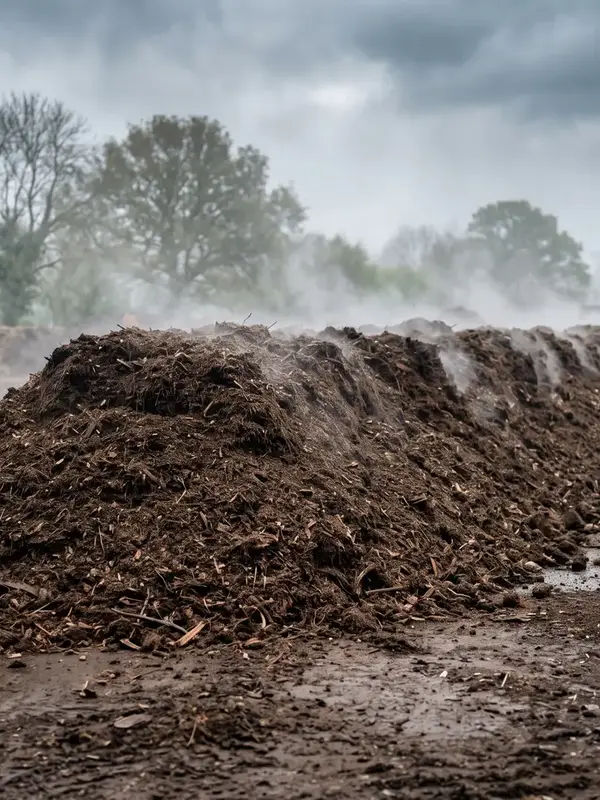
Compost Delivery in Simi Valley, CA, Sold by the Cubic Yard
Bulk compost delivered in Simi Valley, CA. Dark brown color.
Starting from $622.92 delivered to Simi Valley for 2 yards, our minimum order
Compost delivery in Simi Valley, CA lets homeowners rebuild soil in one order instead of carrying bag after bag home from a store. Compost is sold by the cubic yard, so you order the volume your beds or lawn actually need, enter your ZIP, and see the delivered price before you check out. Simi Valley sits in Ventura County on the northwest side of the Los Angeles metro area, and many properties here are hillside lots or yards that were graded during construction.
Why Simi Valley yards need compost
Graded lots often lose their topsoil, and what remains can be thin, rocky or packed hard. Clay pockets hold water and drain slowly, while sandy patches let it run straight through. Compost adds organic matter that loosens clay and helps sandy ground hold moisture. Spread as a top dressing around established shrubs, it keeps feeding the soil underneath. On a slope, a light layer raked in before planting gives seed and roots a better start than bare dirt, and it slows loose soil from washing downhill during heavy rain.
Common ways homeowners use it
- Raised vegetable beds and in-ground garden rows
- Top dressing for lawns and established shrub beds
- Planting holes for trees and perennials
- Mixing into clay-heavy soil ahead of seeding
#57 Crushed Stone and Pea Gravel are sold by the ton and suit driveway bases, paths and drainage areas where compost would wash out.
For planting holes, mix compost into the backfill rather than filling the hole with it alone. Roots then grow out into the native soil instead of stopping at the edge of a pocket of amended material.
How to work out how much compost you need
Compost is measured in cubic yards. Multiply the length of the area in feet by its width in feet, multiply that by the depth in inches, and divide the result by 324. A 20 foot by 10 foot bed spread 2 inches deep comes to about 1.2 cubic yards. That falls under the 2 cubic yard minimum, so you would order 2. Measure each bed on its own, add the totals together, and round up so the corners and low spots are covered.
If you would rather skip the arithmetic, the calculator works from the same length, width and depth numbers, so you can check your result against it before ordering.
Depth guide for typical Simi Valley projects
- Lawn top dressing: a thin layer, about a quarter inch to half an inch
- Established shrub beds: a top layer of roughly 2 inches, kept off the stems
- New garden beds: 3 to 4 inches worked into the top 6 inches of soil
- Tree planting holes: a generous handful mixed into the backfill, not a full fill
How compost pricing works in Simi Valley
The delivered price for your ZIP is calculated live and shown on the page, so the figure on the page matches the cubic yards in your cart. Larger orders get a lower rate per cubic yard, which makes one bigger order cheaper per yard than several small ones placed over a season.
Delivery to Simi Valley and nearby towns
The delivery in Simi Valley page explains how orders reach the city.
Towns close to Simi Valley include Thousand Oaks, about 8 miles away, Oxnard at about 25 miles, Ventura at about 28 miles, Los Angeles at about 32 miles and Torrance at about 38 miles.
Ordering compost for a Simi Valley project
Choose compost from the product list, pick the number of cubic yards, and enter your ZIP. Then confirm the order.
You can compare the wider state listings on Compost in California if you are still deciding on a material. For a first order, start with the cubic yard figure from your bed measurements. If the project grows, a second delivery is a separate order, so plan the total up front where you can.
About Compost
About this material
Compost is decomposed plant and organic matter that has broken down into a dark brown, crumbly material with an earthy smell. It is sold by the cubic yard, and a cubic yard typically weighs around 1,000 pounds, so even a small order is a real amount of material to spread.
Gardeners use it to improve soil structure, add organic matter and feed the microbes that help roots take up nutrients. Fast-draining ground gains water-holding capacity over time, and heavy clay becomes easier to dig and plant.
In Simi Valley, compost suits raised beds, slope plantings and lawn areas where thin soil shows through. It can be spread on top, raked into the upper few inches or mixed into planting holes, depending on the job.
The delivered price for your ZIP is shown on the page before checkout, and orders start at 2 cubic yards.
What Compost costs in Simi Valley
In the Simi Valley market, compost is sold by the ton and priced at the gate before delivery is added on. Send your ZIP and load size and we will send back a same-hour quote with the truck rate and the per-ton figure spelled out. One ton covers about 216 sq ft at a 3 inch finished depth, so a 400 sq ft driveway pad runs roughly 2 tons.
How crews use Compost in Simi Valley
Crews working out of Simi Valley tend to call for compost on a few repeat jobs each week. The first is planting bed gravel, typically laid in tight urban lots and infill builds with a base lift compacted before the finish course goes on. With a population around 125,778, Simi Valley pulls a mix of single-truck homeowner orders and contractor full-loads through the season.
Delivery day in Simi Valley
On the day of the drop, the dispatcher pulls the closest yard, batches your ticket with other Simi Valley stops, and sends a window the night before. Tandem-axle dumps need at least 12 ft of clear width and 14 ft overhead to set the bed; tri-axles need 14 ft of clearance on both counts and a level pad to tip safely. Standard lead time on this lane is Mon-Sat, with same-day windows held open for orders that hit the desk before 11 AM and clear payment.
Related materials we deliver in Simi Valley



Estimate how much you need
Work out your material
A planning figure, not a guarantee. Order roughly a tenth extra to cover settling and uneven ground.
Browse more
Available in nearby cities
Plan your project
Related guides
 GUIDEGravel Size Chart: Pea Gravel to Crushed StoneA gravel size chart showing pea gravel, crushed stone and river rock diameters side by side, so you can match the right size to your project.Read guide →
 GUIDEThe Different Types of Gravel and How to ChooseA plain-language guide to the main types of gravel, covering pea gravel, crushed stone, river rock and decomposed granite.Read guide →
 GUIDEWhat Are Screenings? A Guide to Crushed Stone FinesScreenings are fine crushed stone used for paver bases, joint fill and walkways. See what screenings are, common types, and mistakes to avoid.Read guide →
 GUIDEWhat to Put Under River Rock for Landscaping BedsHere is what to put under river rock landscaping: a compacted base where needed, then landscape fabric, then rock, to stop weeds and settling.Read guide →
Frequently Asked Questions
How do I keep compost from washing off a hillside bed?
Rake the compost lightly into the top inch of soil instead of leaving it loose on the surface, and plant soon after so roots start holding it. A thin layer of coarse mulch over the top also slows runoff. On a steeper slope, a low edge of stone or timber along the downhill side keeps heavy rain from carrying material away.
When is the best time of year to spread compost in Simi Valley?
Fall through early spring suits most planting beds, since roots settle in before the dry summer heat. Avoid spreading right before a heavy storm on a slope, when rain can carry loose material downhill. In midsummer, compost dries out fast on bare ground, so water it in the same day you spread it, or wait for cooler weather.
How do I measure an oddly shaped or sloped bed?
Break the bed into rectangles, work out each one separately and add the results. For a curved edge, picture a rectangle that fits the average width and use that. On a slope, measure along the ground rather than straight across, since the surface is longer than its footprint. Small errors even out once you add a little margin to the total.
Can I use compost to fill low spots in my yard?
Not on its own. Compost shrinks as it breaks down, so a thick fill sinks again within a season or two and can leave a dip. It belongs in planting areas where its job is to feed soil. For a low spot that must stay level, use a firm fill material and put a few inches of compost on top for planting.
Can I mix compost into the soil before seeding a lawn?
Yes, and it is one of the better times to do it. Spread a layer over the bare ground, rake or till it into the top few inches, then level the surface and sow seed. Mixing it in gives new roots loose, fed soil to grow into, which matters on the packed ground common on graded lots.
Does compost help clay soil in Simi Valley?
Compost helps clay by adding organic matter that opens up tight soil structure. Over several seasons, clay that was hard to dig becomes easier to work and drains more evenly. Mix it into the top several inches of the bed before planting, and add more each season rather than expecting one application to fix the whole soil profile.
Can compost go on a vegetable bed that already has plants?
Yes, as a side dressing. Spread a thin layer between rows or around each plant, keeping it off the stems, and water it in lightly. This feeds a crop that is already growing without digging near its roots. Do it once or twice in a season and not with a heavy hand.
What can I do with compost left after the beds are done?
Use it on a lawn patch, in containers or around a young tree. Until then, keep the pile in a shaded spot and cover it so the top does not dry out or wash away in rain. Covered compost holds its quality for weeks, so there is no rush to spread it all in a single weekend.