
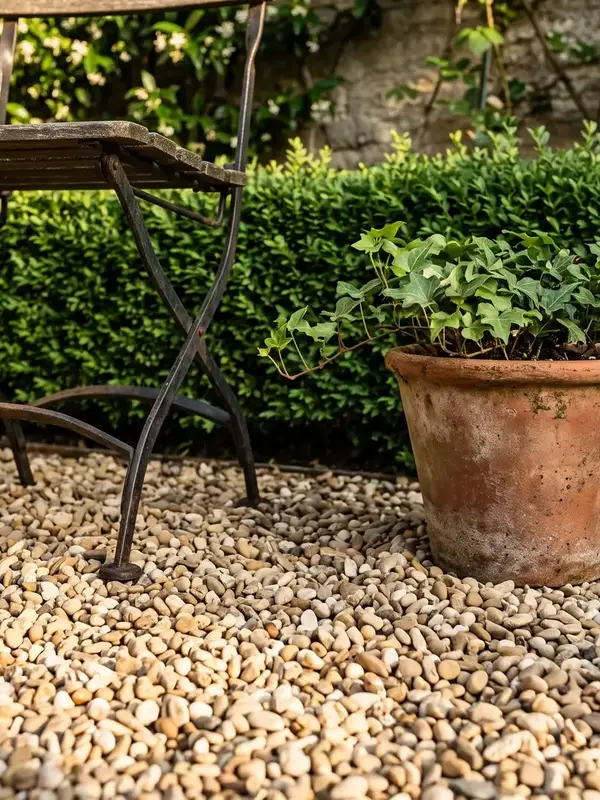
Pea Gravel Delivery in DeSoto, TX for Garden Paths
Bulk pea gravel delivered in DeSoto, TX. Stone size 1/4 - 3/8. Tan / mixed color.
Starting from $593.63 delivered to DeSoto for 2 tons, our minimum order
Pea gravel delivery in DeSoto, TX suits homeowners who want a clean, tan layer for a garden path, a drainage trench or the border around a patio. DeSoto sits about 13 miles from Dallas and Grand Prairie, and about 15 miles from Mansfield, so most of the planning comes down to your own yard.
Where Pea Gravel Works Best Around DeSoto Homes
Most DeSoto projects fall into a few groups. Pick the one that matches your yard, since each asks for a slightly different depth and edge.
- Garden paths and stepping routes between planting beds
- Drainage trenches along a downspout or a low corner of the lot
- Edging along patios, walkways and planting beds
- Decorative top dressing over a layer of larger base stone
A drainage trench is the job where the stone does the most work. Slope the bottom of the trench so water runs toward the outlet instead of pooling at one end, then lay the pea gravel so its top sits level with the lawn. A trench with a flat bottom holds water and never empties out.
How Much Pea Gravel You Need in DeSoto
Measure the area in feet, multiply length by width, then multiply that number by the depth in inches and divide by 324. The result is cubic yards. Pea gravel weighs about 1.4 tons per cubic yard, so multiply again to get tons. Add roughly one extra inch of depth to the figure, because loose stone sinks into the soil and gets pushed around by foot traffic over time.
The calculator does this math for you. Enter the area and the depth, and it returns a tonnage you can order against.
Pricing for Pea Gravel Delivered to DeSoto
Pea gravel sells by the ton, and every price on this page includes delivery. The figure for your ZIP appears as you choose a quantity, so you see the full cost before you commit. Larger orders get a lower rate per ton, which means a bigger job costs less per ton than a small top-up. Orders start at 2 tons.
Laying Out the Area Before You Order
Run a garden hose along the planned shape of a path or trench before you measure. Walk it, bend it and look at it from the kitchen window. The hose shows corners that look fine on paper but cut awkwardly across a lawn, and it gives you a true length to use in the math above.
A Sample Path Project in DeSoto
Take a path 30 feet long and 3 feet wide, laid 2 inches deep. That covers 90 square feet, which works out to a little over half a cubic yard. The stone for that path weighs under a ton, so the 2-ton smallest order covers the path with stone to spare.
Spreading Pea Gravel Evenly
Rake the stone out to a uniform depth before you walk on it, and work from the far end back toward the driveway so you do not step on finished areas. A plain garden rake and a flat shovel handle most small beds. For a path, a board laid across the top helps you level the surface without leaving footprints.
Ordering Pea Gravel for Your DeSoto Address
Before you order, pick a drop spot the truck can reach without crossing soft lawn or squeezing through a tight gate. Mark the spot with a stake or a bucket so the driver knows where to dump the load. If the stone has to travel more than a short distance by wheelbarrow, plan that route first, since a full ton is heavy to move by hand.
For details on local drop-off at homes in the city, see our page on delivery in DeSoto.
Other Materials for DeSoto Projects
Mulch is sold by the cubic yard, so it suits planting beds where you want a light, organic cover rather than stone. Premium Screened Topsoil is sold by the ton and works well for leveling low spots before any gravel goes on top.
If you are comparing several cities, the Pea Gravel in Texas hub lists the Texas city pages for this material in one place.
About Pea Gravel
About this material
Pea gravel is a rounded, smooth stone that falls in a narrow size band, here roughly 1/4 to 3/8 inch across. Our stock is tan and mixed, so a load shows a blend of light and darker pieces rather than one flat color. The rounded faces are what set it apart from crushed stone, which has sharp edges that lock together.
Because the pieces are small and round, pea gravel shifts under foot more than angular stone does, so it suits areas where the footing is not the main concern. Water finds the gaps between the stones, which is why it works well in drainage trenches. Each cubic yard weighs about 2,800 pounds, and the sales unit is the ton, which equals 2,000 pounds.
It is a decorative product. It looks best in a clean, even layer rather than in heaps, and a thin layer over the soil reads as part of the landscape.
What Pea Gravel costs in DeSoto
In the DeSoto market, pea gravel is sold by the ton and priced at the gate before delivery is added on. Send your ZIP and load size and we will send back a same-hour quote with the truck rate and the per-ton figure spelled out. One ton covers about 77 sq ft at a 3 inch finished depth, so a 400 sq ft driveway pad runs roughly 6 tons.
How crews use Pea Gravel in DeSoto
Crews working out of DeSoto tend to call for pea gravel on a few repeat jobs each week. The first is patio gravel, typically laid in tight urban lots and infill builds with a base lift compacted before the finish course goes on. The second is walkway gravel, which lands here in dense neighborhoods where curb access is short and usually ships as a 4 to 8 ton order. With a population around 56,711, DeSoto pulls a mix of single-truck homeowner orders and contractor full-loads through the season.
Delivery day in DeSoto
On the day of the drop, the dispatcher pulls the closest yard, batches your ticket with other DeSoto stops, and sends a window the night before. Tandem-axle dumps need at least 12 ft of clear width and 14 ft overhead to set the bed; tri-axles need 14 ft of clearance on both counts and a level pad to tip safely. Standard lead time on this lane is Mon-Sat, with same-day windows held open for orders that hit the desk before 11 AM and clear payment.
Related materials we deliver in DeSoto
 Price by ZIP
- Size3/8″
- Density2800 lb/yd³
- ColorMixed earth
 Price by ZIP
- Size1 - 3″
- Density2700 lb/yd³
- ColorMixed natural
 Price by ZIP
- Size0 - 1/4″
- Density3000 lb/yd³
- ColorTan, gold
Estimate how much you need
Work out your material
A planning figure, not a guarantee. Order roughly a tenth extra to cover settling and uneven ground.
Browse more
Available in nearby cities
Plan your project
Related guides
GUIDEGravel Size Chart: Pea Gravel to Crushed StoneA gravel size chart showing pea gravel, crushed stone and river rock diameters side by side, so you can match the right size to your project.Read guide →GUIDEThe Different Types of Gravel and How to ChooseA plain-language guide to the main types of gravel, covering pea gravel, crushed stone, river rock and decomposed granite.Read guide →GUIDEHow Much Does Gravel Cost? A Practical Pricing GuideHow much does gravel cost and why does it vary? See the real factors behind ton pricing, delivery, and order size before you buy.Read guide → GUIDEWhat Is Crushed Stone? Sizes, Uses and Buying BasicsCrushed stone is quarried rock crushed and screened into angular pieces sold by the ton. Here is what it is, how it is graded, and where to use it.Read guide →
Frequently Asked Questions
How do I keep pea gravel from spreading into the lawn?
A permanent edge does most of the work. Metal or plastic landscape edging, a row of pavers or a poured concrete border will hold the stone in place while you walk on it. Set the edge a little above the stone line so the gravel does not spill over as it shifts. Without an edge, expect some stones to migrate onto the grass, especially along the outside of a curve.
Does pea gravel need landscape fabric underneath?
Landscape fabric helps in beds where you want to slow weeds from pushing up through the stone. Lay a permeable fabric over the soil, overlap the seams, and spread the gravel on top. Skip solid plastic sheeting, since it traps water under the stone. In a drainage trench, a fabric lining can also keep fine soil from clogging the gaps between the stones over time.
Does clay soil change how I prepare the ground under a gravel path?
It can. Clay holds water and lets loose stone sink, so strip the grass, level the soil and firm it by tamping before any gravel goes down. Check that the base slopes slightly to one side so rain leaves the path instead of pooling. Sandy ground drains faster and needs less work, but the same leveling and firming steps still apply.
Does pea gravel need to be sealed or treated?
No. Loose pea gravel stays as it is and does not need a sealer, a stain or regular treatment. Some people rinse the stone with a hose to bring back its color after a dusty stretch, which is an optional step. Plan on topping up thin spots over the years, since stone that moves a little under foot will need adding to now and then.
What happens if the delivery lands in the wrong spot?
Stone that lands on the wrong part of the lot is usually moved by hand or with a wheelbarrow. On delivery day, have someone at the address to point out the spot and keep cars off the approach. If the truck cannot reach the spot you chose, use the contact page on this site to ask about access before you place the order.
Can I use pea gravel in a planting bed instead of mulch?
Yes, pea gravel works as a top layer in beds where you want a tidy look and less loose organic material. It does not break down or feed the soil the way bark or compost does. For beds with shrubs that need organic matter, mulch is the better match, and the two can be used in separate zones of the same yard.
Is pea gravel a good choice for a path that gets daily use?
It can be, if the path is wide enough and edged well. Stone paths take the most wear down the center where feet land, so a width of two to three feet gives you room to walk without kicking stones toward the grass.
Can I order a small amount of pea gravel for a single pot or container?
Pea gravel here is sold in bulk, so an order is too large for one container. A bag from a garden center will suit a single pot better. Bulk orders make sense for a path, a trench or a bed that runs across the yard.