
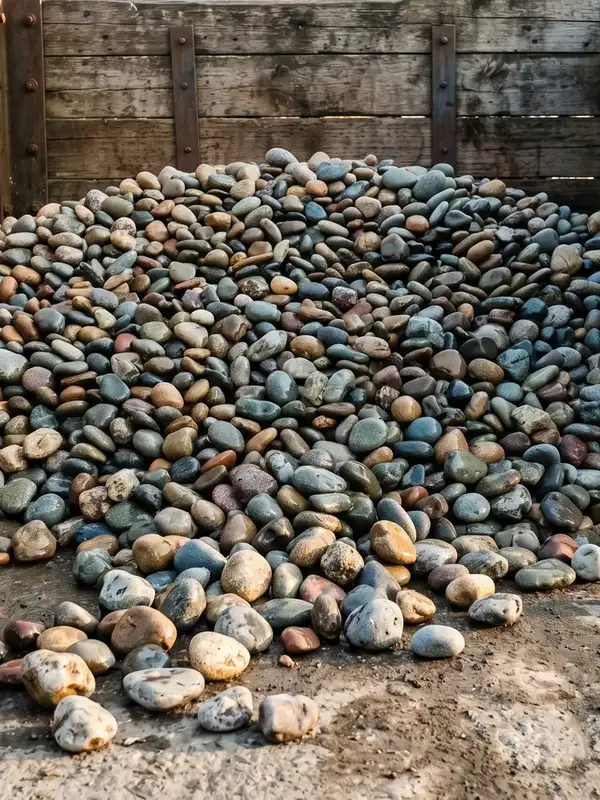
River Rock Delivery in Anchorage, AK
Bulk river rock delivered in Anchorage, AK. Stone size 1 - 3. Mixed natural color.
Starting from $874.43 delivered to Anchorage for 2 tons, our minimum order
River rock delivery in Anchorage, AK covers rounded 1 to 3 inch stones in mixed natural tones, and the smallest order is 2 tons.
River rock delivery in Anchorage, AK
Anchorage is a city of about 290,000 people and long winters. That mix makes landscape stone a practical choice: it does not rot, blow away or need replacing every season. The full range for the state is on the River Rock in Alaska page, and the local rules for getting a truck to your address are on the page for delivery in Anchorage.
River rock here is a smooth, water-worn stone with a mixed natural color. Because it is sold by the ton, you buy by weight rather than by a bucket or bag count, which keeps larger jobs simple to quote.
Where river rock works around Anchorage homes
- Drip lines under eaves: heavy snowmelt off a roof splashes soil onto siding. A stone strip catches it and lets the water drain away.
- Dry creek beds: rounded stones look right in a swale that carries spring runoff across a lot.
- Beds and borders: stone holds its color and shape where you want a clean edge around shrubs and perennials.
- Foundation perimeters: a band of rock keeps planting beds back from the wall.
If you want soft cover for a vegetable bed or a tree ring instead, Mulch is sold here by the cubic yard. For a planting bed that needs growing medium under or beside the rock, Premium Screened Topsoil is sold by the ton.
Frost, snow and the ground under your stone
Anchorage ground freezes hard and thaws unevenly. Lay the rock over landscape fabric on a firm, graded base so stones do not sink into soft soil after the thaw. Keep the surface sloped away from the house, and leave the bed a few inches below any siding or sill so melting snow has somewhere to go.
Plan for snow removal too. A shovel or plow blade will drag loose stones, so keep rock beds off the parts of a driveway edge where the blade rides.
How much river rock you need
Work out the bed first. Anchorage yards can use this math: multiply length in feet by width in feet by depth in inches, then divide by 324 to get cubic yards. This stone weighs about 2,700 pounds per cubic yard, so one cubic yard is roughly 1.35 tons. For a decorative layer, 2 to 3 inches deep is typical.
Say you have a 30 foot by 10 foot border at 3 inches deep. That is about 2.8 cubic yards, or close to 3.75 tons. On uneven Anchorage ground, round up a little, since a short load means a second delivery. The river rock calculator does this conversion for any shape and gives you the tonnage to enter.
Choosing a look that suits the lot
Mixed natural tones blend with spruce, birch and the gray of local weathered siding, so the stone rarely looks out of place beside a house. Pair it with a few larger boulders or a band of edging if you want a defined shape. Pea Gravel is a finer alternative for paths, while river rock suits wide beds where you want a chunkier texture and visible variety between stones.
Think about maintenance as well. A bed of smooth stone needs little beyond an occasional rake, which suits owners who would rather spend summer weekends outdoors than redoing cover every year.
Ordering for your address
Enter your ZIP on the product page and the delivered price for that address is calculated live. Because the price already includes the trip to your site, there is no separate quote to chase. Larger orders get a lower rate per ton, which is worth checking if you are doing a driveway border and a backyard bed in one go.
Make sure the driver can reach the spot you want the stone dropped, with clear overhead space and firm ground. Tell us about any gate width or steep approach when you order.
About River Rock
River rock is smooth, water-worn stone in a 1 to 3 inch size with a mixed natural color. The rounded shape comes from years of tumbling in moving water, so edges are soft and surfaces feel even underfoot. It is used as decorative ground cover, in dry creek beds, around foundations and along garden borders.
The stone does not decay, does not need topping up the way organic cover does, and holds its color through rain and snow. It weighs about 2,700 pounds per cubic yard and is sold by the ton, so you can order by weight from a quick measurement. In Anchorage, the smallest order is 2 tons, and the delivered price shows for your ZIP.
What River Rock costs in Anchorage
Local Anchorage yards quote river rock by the ton; the delivered number includes fuel, the truck, and the haul. Send your ZIP and load size and we will send back a same-hour quote with the truck rate and the per-ton figure spelled out. A ton of this material spreads across about 80 sq ft when laid 3 inches deep, useful when you are sizing a patio base or a walkway run.
How crews use River Rock in Anchorage
In and around Anchorage, river rock shows up most often on two project types. The most common deployment is decorative gravel, often in tight urban lots and infill builds in two to three inch lifts. Second on the list is drainage gravel, which we see in dense neighborhoods where curb access is short on partial-truck deliveries. At roughly 291,000 people, the Anchorage order mix leans toward 3 to 8 ton residential drops with the occasional 16 ton job for a contractor.
Delivery day in Anchorage
A typical Anchorage drop is dispatched from the closest yard with a two hour window and a heads-up call once the truck is loaded. Tandem trucks want a 12 ft lane in and out; tri-axles need 14 ft, and both want firm ground at the tipping spot so the load releases cleanly. Standard lead time on this lane is Mon-Sat, with same-day windows held open for orders that hit the desk before 11 AM and clear payment.
Related materials we deliver in Anchorage
 Price by ZIP
- Size1/4 - 3/8″
- Density2800 lb/yd³
- ColorTan / mixed
Price by ZIP- Size3/8″
- Density2800 lb/yd³
- ColorMixed earth
 Price by ZIP
- Size0 - 1/4″
- Density3000 lb/yd³
- ColorTan, gold
Estimate how much you need
Work out your material
A planning figure, not a guarantee. Order roughly a tenth extra to cover settling and uneven ground.
Browse more
Available in nearby cities
Plan your project
Related guides
GUIDEGravel Size Chart: Pea Gravel to Crushed StoneA gravel size chart showing pea gravel, crushed stone and river rock diameters side by side, so you can match the right size to your project.Read guide →GUIDEThe Different Types of Gravel and How to ChooseA plain-language guide to the main types of gravel, covering pea gravel, crushed stone, river rock and decomposed granite.Read guide → GUIDEWhat to Put Under River Rock for Landscaping BedsHere is what to put under river rock landscaping: a compacted base where needed, then landscape fabric, then rock, to stop weeds and settling.Read guide →GUIDEHow to Clean River Rock and Restore Its ColorLearn how to clean river rock landscaping with rinsing, soap and vinegar methods, plus common mistakes to avoid for a brighter, longer lasting rock bed.Read guide →
Frequently Asked Questions
What size is the river rock sold in Anchorage?
The stones run about 1 to 3 inches across and come in a mixed natural color, so you will see tans, grays and browns in the same load. They are rounded and smooth, which makes them comfortable to look at and easy to spread by hand or with a rake over a prepared bed.
Is river rock good for a driveway?
It can work for a decorative strip beside a driveway, but rounded stones shift under tires and do not lock together the way angular crushed rock does. For the traveled part of a drive, a crushed stone base is the better choice. Keep river rock for edges, borders and landscaped areas.
How do I stop weeds from coming up through the stone?
Lay landscape fabric over cleared, level ground before the rock goes down, and pull any seedlings that blow in and root in the stone itself. Fabric blocks growth from below. A layer thick enough that you cannot see the fabric through the gaps also shades what is underneath.
How do I turn my calculator result into an order?
The calculator gives cubic yards first, then a tonnage for this stone. Enter that tonnage as your order quantity. If the figure comes out under 2 tons, raise it to 2, which is the smallest order we take. Keep your length, width and depth notes handy in case you want to rerun the numbers for a second bed.
Will the stones stay clean looking?
Spruce needles, leaves and silt settle between stones over a few years. A leaf blower on low or a stiff rake brings most of it off the surface. Occasional hosing also brings back the natural color, since the stones are smooth and shed dirt more easily than rough rock.
Can I use river rock around a fire pit?
Keep it well back from the flame area. River rock that has absorbed water can crack or pop when heated, because trapped moisture turns to steam. Use it for the surrounding landscape, and choose fire-rated material for the ring itself, as the manufacturer of your pit recommends.
How deep should the layer be on a slope?
On a gentle slope, 3 inches holds better than a thin spread, because stones near the top slowly migrate downhill. On steeper ground, add a border edge or step the bed in tiers. Steeper areas often need more tons than a flat calculation suggests.
Can I get river rock delivered while there is snow on the ground?
Yes, ordering through winter works, but frozen ground and packed snow change how the stone behaves. Stone dropped onto slush mixes with it and settles unevenly once the melt arrives. Scraping down to a firm surface gives you a cleaner spread in spring, and a tarp under the drop point keeps the pile from sinking into soft ground.